What is GoCrypto? The short, honest answer
Search "what is GoCrypto" and you will find two kinds of pages: marketing that calls it a gateway to crypto riches, and app-store boilerplate that tells you nothing. Here is the auditor's version. GoCrypto — store name Gocrypto: Crypto Trading, package academy.gocrypto.trading — is a mobile simulator that recreates the experience of trading and mining cryptocurrency using entirely virtual money, bolted onto an interactive educational academy. It is published by MOBILE EDTECH SOLUTIONS LIMITED, an edtech company registered in Limassol, Cyprus, and it has been on Google Play since August 2024, where it now reports over 25,000,000 downloads and a rating of roughly 4.56 out of 5 across about 170,000 reviews (checked July 2026). On iOS it holds around 4.7 stars.
Read that description again and notice what is missing: nothing about deposits, earnings or payouts. That is not an oversight. The app has no payment rail into its trading game and no rail out. You cannot fund it with real money, and you cannot extract real money from it — a point the developer itself makes with the disclaimer that success in the simulator does not guarantee success in actual trading. Everything else on this page is detail; that fact is the foundation. We gave it a whole page — can you withdraw money from GoCrypto? — because scammers love exploiting people who miss it.
The trading simulator: how the core loop works
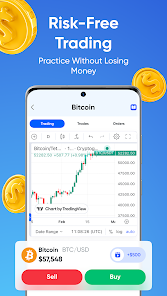
Open the app and you receive a virtual starting portfolio — play money, but denominated like the real thing. From there the loop is simple: watch live market quotes stream in around the clock, decide what to buy or sell, and place simulated trades on the exchange screen. The quotes are the app's best feature. They track real markets in real time, which means the charts you practice on are genuine market history unfolding live, not a canned replay. When Bitcoin drops 4% on a Sunday night, your virtual portfolio drops with it. That authenticity matters: chart-reading reflexes built on live data transfer to real platforms far better than reflexes built on synthetic curves.
The trade execution, however, is where simulation and reality part ways. Your orders fill instantly at the quoted price, every time, in any size. Real exchanges do not work like that — there are order books, spreads, partial fills and slippage, and the difference is measured in real money. We walk through the whole exchange screen, including its small simulated fee, in the trading guide. For now, hold this model in your head: GoCrypto gives you a real market's prices with a toy market's mechanics.
Blow up your portfolio — and if you trade aggressively, you will — and you can rebuild it through rewards and time. That resettability is the pedagogical point. A real exchange charges tuition in lost savings; the simulator charges it in mild embarrassment.
The academy: the part that actually earns the "edtech" label
The developer calls itself an edtech company, and the academy is the evidence. It is a track of short interactive lessons and challenges covering the fundamentals: what a candlestick shows, how market and limit orders differ, what portfolio diversification means, how volatility behaves. Lessons end in quizzes, progress unlocks further content, and the whole thing is structured like a language-learning app rather than a textbook.
Our assessment after completing the track twice: the material is genuinely decent on mechanics and refreshingly quiet on hype. It does not promise profits and does not push you toward any real venue. Where it is thin — inevitably — is on the ugly parts of real trading: fee mathematics, tax consequences, custody risk, the statistics of how many retail traders actually lose money. No gamified academy anywhere covers those well, which is one reason this site exists. Treat the academy as a solid first semester, not a complete education.
The mining simulator: an idle game wearing a crypto costume
The second big module is a mining simulator: you assemble virtual rigs, upgrade components, and watch virtual coins accumulate. Mechanically it is an idle/incremental game — the genre where numbers go up while you sleep — reskinned with mining vocabulary.
Does it teach real mining? Honestly, no. Real mining economics are a brutal spreadsheet of hash rates, electricity prices, hardware depreciation, pool fees and difficulty adjustments. The sim gestures at these ideas but cannot model the one that decides everything: electricity cost versus coin price. What it does teach, gently, is the concept that mining is capital-intensive infrastructure rather than free money — and for a total beginner, even that is a useful correction to YouTube fantasies. Enjoy it as a game. Do not buy a GPU because of it.
The rewards economy: engagement machinery in plain sight
Wrapped around both simulators is a dense layer of engagement mechanics, and we want to describe it clinically, because this layer is why the App Store slaps an 18+ "frequent simulated gambling" label on the app.
| Mechanic | What it does | What it is for |
|---|---|---|
| Daily rewards | Log in, collect a virtual bonus; streaks grow it | Habit formation — the classic retention hook |
| Weekly competitions | Trader leaderboards reset weekly | Social comparison, a reason to return and trade more |
| Achievements | Milestones unlock virtual properties | Long-term progression and collection instinct |
| Marketplace and auctions | Trade virtual items with other players | A meta-economy that deepens investment in the game |
| Ads and in-app purchases | Ads throughout; purchases speed things up | How the developer actually earns money — from advertisers and impatient players, not from your trades |
Follow the money and the business model becomes obvious: you are not the customer of a brokerage; you are the audience of an ad-supported game. That is a far more honest model than many "free" crypto apps, but it has a psychological cost. Daily streaks and leaderboards are the same reinforcement loops casinos use, tuned by people who understand habit science.
The two GoCryptos: an entity disambiguation you actually need
Here is the confusion that generates half the search traffic to this site. There are two completely unrelated products called GoCrypto, and mixing them up leads people to genuinely wrong conclusions.
| GoCrypto simulator (this app) | GoCrypto payments | |
|---|---|---|
| Company | MOBILE EDTECH SOLUTIONS LIMITED | Eligma Labs d.o.o. |
| Country | Limassol, Cyprus | Ljubljana, Slovenia |
| Website | gocrypto.academy | gocrypto.com |
| What it is | Trading and mining simulator plus academy | Crypto payment network for merchants |
| Token | None — all balances are virtual | GoC token |
| Wallet | None — no keys exist | Companion wallet app, formerly "Elly" |
| Real money involved | Never | Yes — real crypto and euro payments at shops |
The Slovenian product lets physical and online merchants accept cryptocurrency and euros; it is real payments infrastructure with a real token. The Cypriot product is a game. They share nothing but a name. This matters practically: people search "GoCrypto wallet," find articles about the Eligma wallet, and conclude the simulator holds real coins. It does not, and our wallet guide dismantles that misunderstanding in detail. It also matters for reviews — some angry one-star reviews on either product appear to be aimed at the other one entirely.
Who is behind the app, and does the paper trail check out?
MOBILE EDTECH SOLUTIONS LIMITED is registered in Limassol, Cyprus, operates the official site gocrypto.academy, and lists info@gocrypto.academy as its contact. The app appeared on Google Play in August 2024 and has been updated steadily since — version 1.3.x shipped in April 2026, per the official Google Play listing. On iOS it requires iOS 15.0+, weighs about 128 MB, and runs on iPhone, iPod touch, Apple Silicon Macs and Apple Vision, per the App Store listing. It ships in English and 16 more languages, from Spanish and Portuguese to Indonesian, Arabic, Japanese and Korean.
Cyprus raises eyebrows in crypto circles because it is a popular base for brokers of varying quality. But context matters: this company does not need a financial license, because it never touches client money — there is no client money. A regulated activity requires regulation; a game requires app-store compliance. On that score the paper trail is consistent and boring, which is exactly what you want. Our full legitimacy audit goes deeper, including the ratings distribution and the impersonation problem.
Who actually benefits from GoCrypto?
Three groups, in our experience. Absolute beginners get the most: if you cannot yet read a candle chart or explain a limit order, two weeks in the simulator will teach you more than twenty explainer videos, because you learn by doing and the mistakes are free. Curious skeptics — people who suspect crypto trading is not for them — get a cheap way to confirm or refute that suspicion before any exchange gets their passport scan. And educators get a demonstration tool, with the significant caveat of the 18+ rating: this is not classroom software for minors, whatever the cartoon aesthetics suggest.
Who does not benefit: anyone seeking income (there is none), experienced traders (nothing new here), and anyone for whom gambling-style reward loops are a hazard rather than a mild annoyance. We keep repeating this because the app's own age rating repeats it.
The limitations: what a simulator structurally cannot teach
We respect what GoCrypto does well, so let us be equally precise about what it cannot do — not because the developer is lazy, but because these things are unsimulatable.
- Real-money emotion. The fear when actual savings drop double digits, the greed that makes you oversize a winner — no game can rehearse feelings that only real stakes produce.
- Slippage and liquidity. Simulator fills are instant and perfect. Real order books have depth, spreads widen in volatility, and large orders move the price against you.
- The full fee stack. Maker/taker fees, spread costs, network withdrawal fees — on real venues these quietly eat strategies that look profitable in a frictionless sandbox.
- Custody and security. There are no keys, no
seed phrase, no2FA-protected withdrawal whitelist to manage. Yet custody mistakes destroy more beginner money than bad trades do. Start with custodial vs non-custodial basics. - Regulatory reality. KYC checks, MiCA-era disclosures in the EU, tax reporting — the entire administrative layer of real trading simply does not exist in the game.
⚠️ The riskiest moment in a simulator user's life is the week they graduate to real money while their confidence is calibrated to idealized fills and zero consequences. If that is where you are heading, read our guide on what the simulator cannot teach before you deposit a single euro — overconfidence is the most expensive souvenir this genre hands out.
What to do if you already misunderstood what the app is
Rescue advice, because we get these emails. If you paid for in-app purchases expecting real returns: the purchases were for virtual goods, so there is nothing to recover from a market — but if you feel misled, request a refund through Google Play or Apple within their standard windows, and both stores do grant them case by case. If you gave your card or crypto to a website claiming to be GoCrypto with "real payouts": that was an impersonator, not this app — report it to your bank immediately, file a complaint with your local cybercrime unit, and read the recovery-scam warning in our withdrawal guide before anyone offering to "get your money back" finds you. And if you simply spent three months grinding a virtual fortune you thought was real: you lost nothing but time, and you accidentally learned the most valuable lesson in crypto — verify what a platform actually is before you invest anything in it, attention included.
Our verdict: a classroom, not a casino — but check the exits
So, what is GoCrypto? A competently built, honestly disclaimed trading simulator and academy, monetized through ads and in-app purchases, made by a Cypriot edtech company, with real live market data and entirely unreal money. It earns its 25 million downloads on the merits of the core idea: markets are best learned by touching them, and this is the only way to touch them for free.
Our advice is the same we would give a younger sibling. Install it from the official store — here is how to do that safely — use a low-value email at signup, run the academy, trade the sandbox until candles and orders are boring, and treat every reward loop with the mild suspicion it deserves. Then, if and only if the interest survives, start learning the parts the game cannot show you. The simulator is the first chapter of trading literacy. Just never confuse it for the book.
Done practicing?
Open a Live Trading Account →