Learning how to trade on GoCrypto takes about four minutes. Learning how to trade on GoCrypto in a way that survives contact with a real exchange takes a couple of months and a plan — and that’s the guide we’ve written. We’ve pushed hundreds of simulated orders through the app’s exchange screen, competed in the weekly leaderboards, and mapped exactly where the simulation flatters you. Everything below assumes one non-negotiable fact: GoCrypto is a simulator. The quotes are real, streamed live 24/7; the money is not, ever. No deposits, no withdrawals, no real profits. That’s its greatest feature and its deepest limitation, and this page is about exploiting the first while respecting the second.
The exchange screen, decoded
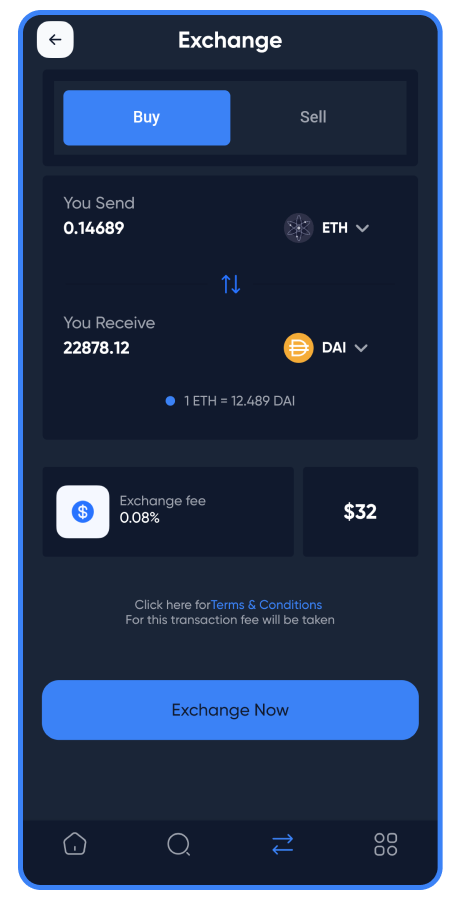
Open the trading section and you’re looking at a deliberately simplified exchange: a price chart, a pair selector, Buy and Sell tabs, an amount field, and your virtual balance. It borrows the visual grammar of real trading apps — which is the point, since interface familiarity is half of what a simulator can transfer.
What each element actually does:
- The chart plots real market prices. Switch it to candlestick view immediately (we cover reading candles below); the line view hides most of the information.
- The pair selector offers the major cryptos against a virtual dollar-stable balance. As a beginner, live on BTC and ETH pairs. Small caps teach mostly chaos.
- Buy/Sell tabs flip the direction of your simulated position. There’s no short-selling complexity here — selling reduces what you virtually hold.
- The amount field is where discipline lives or dies. The app will happily let you go all-in with one tap. Real traders never do; more on sizing shortly.
- The confirmation step shows the simulated fee taken from the trade. Read it every time — fee awareness is a trainable reflex.
Before your first trade, do the first few academy lessons. We’re usually cynical about in-app "academies" (they’re often ads with a syllabus), but GoCrypto’s interactive lessons are genuinely its strongest component, and the exchange screen assumes their vocabulary. If you haven’t installed the app yet, our safe download guide gets you the real build and not one of its malware-laced impersonators, and the sign-up walkthrough covers registering without oversharing.
Your first virtual trade, step by step
- Pick one pair and stay there. BTC/USDT is the classic classroom. Multi-pair dabbling on day one teaches nothing except tab-switching.
- Decide the size before the chart seduces you. Use 1–2% of your virtual portfolio. Yes, it feels absurdly small. That’s the correct feeling; professionals size like cowards and survive like kings.
- Write the reason down. One sentence: "Buying because X; taking profit at Y; cutting the loss at Z." No sentence, no trade. This single rule filters out ninety percent of impulse clicks.
- Execute and note the fee. Tap Buy, and on the confirmation, find the simulated fee line. On a worked example: a 1,000-unit virtual position at a 0.08% fee costs 0.8 units. Trivial? Multiply by a hundred trades a month and it’s 80 units — fees are a silent strategy tax, and the sim is teaching you to feel it early.
- Manage the exit at your pre-written levels. Hit Y or Z, close the position accordingly, no renegotiating with yourself mid-trade. The renegotiation urge you’ll feel — even over fake money — is the most honest preview of real trading the app offers.
- Journal it. Result, reason, and one lesson, in a notes app. Thirty journaled trades will teach you more about yourself than three hundred unjournaled ones.
Reading candles without the mysticism
Candlestick charts get wrapped in more folklore than any tool in finance, so here’s the desimplified truth. Each candle summarizes one time slice — a minute, an hour, a day, whatever you set. The fat body spans the open and close price; the thin wicks mark the extremes; the color says whether the close beat the open. That’s the whole encoding. Four numbers per candle: open, high, low, close.
What beginners should actually read from them, in order of usefulness:
- Direction and conviction. A string of large same-colored bodies is a trend with momentum. Alternating stubby candles with long wicks is indecision. Trade less during indecision; the chop eats fee-paying beginners alive.
- Wick psychology. A long lower wick means sellers pushed price down and buyers slammed it back — rejection of lower prices. Long upper wick, the mirror story. Wicks are the market arguing with itself, and the body is who won.
- Levels that keep repeating. Zones where price repeatedly stalls or bounces (support and resistance) matter far more than any single candle "pattern". Mark them; plan entries and exits around them.
- Timeframe honesty. The 1-minute chart is noise wearing a trend costume. Learn on the 1-hour and 4-hour views, where structure is visible and your decision rate stays humane.
Ignore, for now, the fifty named patterns — the harami, the abandoned baby, the three advancing soldiers. Pattern astrology comes later, if ever. The simulator’s live chart plus the four bullets above will carry you through your first hundred trades, and the academy lessons reinforce the same ground.
Order types: what the sim has, what real exchanges add
GoCrypto keeps execution deliberately simple — essentially tap-to-trade at the current price, the equivalent of a market order. On a real exchange, you’ll meet a bigger menu, and you should learn the concepts now so the names don’t ambush you later:
| Order type | What it does | In GoCrypto? | Why it matters for real trading |
|---|---|---|---|
| Market | Executes now, at whatever the current price is | Yes — the default tap-to-trade flow | Fast but pays the spread; on thin books it also pays slippage |
| Limit | Executes only at your chosen price or better | Simplified/absent depending on version | The professional default: you set the price, the market comes to you |
| Stop-loss | Closes your position automatically past a loss threshold | You mostly enforce it manually | The seatbelt. Real accounts without stops eventually meet a windshield |
| Take-profit | Closes automatically at your target | Manual, via your written exit rule | Locks the win before greed renegotiates it |
| OCO (one-cancels-other) | Stop and take-profit bracketed together | No | How pros make every trade a pre-decided if-then, not a vigil |
The manual-discipline gap is actually a decent teacher: since the sim won’t auto-enforce your stop, you must — and practicing that self-enforcement on fake money is precisely the rehearsal that matters. The trader who can’t honor a mental stop in a simulator has no chance of honoring one with rent money on the line.
Challenges, leaderboards and the rewards economy
Beyond the exchange screen, the app layers on a game: daily rewards for showing up, challenges tied to lessons and trades, achievements that unlock virtual properties, a marketplace with auctions, and weekly trader competitions ranked on a leaderboard. According to the official listings, this loop — plus ads and in-app purchases — is the entire business model. You are not the customer of a brokerage; you are the audience of a game with real quotes.
Our field notes on each, tested through several competition weeks:
- Daily rewards exist to build a streak habit. Take the free virtual top-ups, but notice the mechanic working on you — the same nudge psychology real exchanges use with "rewards hubs" and trading missions.
- Challenges are the best of the bunch when they push you through academy content. Skip any that push volume for volume’s sake; "make 20 trades today" is anti-education, training you to overtrade.
- Leaderboards deserve real caution. Weekly rankings reward maximum-risk, all-in behavior — a competitor who YOLOs the entire virtual stack on one coin either tops the board or re-rolls next week, with zero downside. That is the exact inverse of survivable trading. Compete for fun if you like, but never mistake leaderboard strategy for trading strategy.
- The marketplace and virtual properties are cosmetic progression. Harmless, occasionally charming, and economically meaningless — nothing there converts to anything outside the app, as we detail in the withdrawal-question page.
⚠️ The competitions pay out virtual rewards only. There are no cash prizes anywhere in GoCrypto — the developer says so plainly. If someone in a Telegram group claims they can convert your leaderboard winnings or simulator balance into real crypto "for a small fee", you have met a scammer mid-script. Block, report, and warn the group.
Five habits worth building in a simulator
Fake money is only useful if it installs real behavior. These are the five habits we’d drill, chosen specifically because they transfer intact to real trading:
- Fixed fractional sizing. Every position is 1–2% of the portfolio, every time, no exceptions for "obvious" setups. The obvious ones are where accounts die.
- The written pre-trade sentence. Entry reason, profit exit, loss exit — before the order, not after. If you can’t write it, you don’t have a trade; you have an urge.
- Loss-taking without ceremony. Hit your stop level, exit, journal, move on. Practicing small clean losses on virtual money is rehearsing the single hardest act in real trading.
- A trade journal you actually reread. Weekly, reread the log and tag your recurring mistake. Everyone has a signature error — revenge trading, early exits, oversizing after wins. The journal makes yours visible while it’s still free to have.
- Scheduled sessions, not ambient trading. Decide when you trade and close the app otherwise. The push notifications want you back hourly; a trader on the app’s schedule instead of their own has already lost the important battle.
What the simulator cannot teach you — read this twice
Here’s the section the app’s marketing will never write, so we will. GoCrypto’s own disclaimer — "success in the simulator does not guarantee success in actual trading" — is carrying more weight than most users realize. Four structural gaps:
Slippage and liquidity don’t exist here. In the sim, your order fills at the on-screen price, always, at any size. On a real order book, your market buy walks up the ask side: big orders in thin markets fill at progressively worse prices, and in a crash, the liquidity you assumed simply isn’t there. Simulated fills are friendlier than real ones by design, and the difference is pure cost you’ve never rehearsed.
The full fee stack is bigger than one number. The sim’s modest per-trade fee is a fine teaching device, but reality adds spreads, maker/taker tiers, funding rates on derivatives, and network fees when you move coins. A strategy that’s profitable at simulator costs can be a slow bleed at real ones. Always re-run the math with the real venue’s full fee schedule before believing a backtest or a sim streak.
Your emotions were never in the trade. A 20% virtual drawdown is a shrug; a 20% real drawdown is a missed night of sleep and a hand hovering over the panic-sell button at the exact bottom. No simulator anywhere solves this — the fear circuits only activate for real stakes. Expect your first real weeks to feel like learning to trade all over again, and size accordingly (smaller than pride wants).
Overconfidence is the product’s side effect. Friendly fills, replenishable balances and reward streaks are engineered to feel good — that’s retention design, and it quietly breeds the belief that you’re better than you are. We consider this the simulator’s single biggest risk, bigger than the ads or the tracking. The antidote is the checklist below, applied without self-mercy. For the broader picture of what the app is optimizing for, see our deep-dive on how GoCrypto really works.
The graduation checklist: are you ready for real money?
Don’t graduate on vibes. Graduate when every line below is honestly true:
- You’ve traded the simulator for 60–90 days including at least one sharp market drop, and followed your written rules through it.
- Your journal shows a stable strategy — not a lucky fortnight — and you can state your edge in one sentence a stranger would understand.
- You’ve recomputed your results using a real exchange’s full fee schedule plus pessimistic slippage, and the math still works.
- You know the difference between an exchange holding your coins and a non-custodial wallet where a lost
seed phraseis gone forever — if not, read our wallet guide before moving a single satoshi. - You’ve chosen a regulated venue deliberately (in the EU, MiCA authorization is now the baseline sanity check), enabled real
2FA, and planned a test withdrawal before any serious deposit. - Your first real stake is money you can lose entirely without changing a single life plan — and it’s sized like it: start at a fraction of what you traded virtually.
Miss a line? Stay in the sandbox longer. It’s free, the market isn’t going anywhere, and the entire point of a simulator is that staying too long costs you nothing while leaving too early costs you real money. When every box checks, move deliberately: small deposit, test withdrawal, tiny positions, same journal. The habits will carry — that’s what you built them for.
Done practicing?
Open a Live Trading Account →